The Battle is Waged on the Cross
33rd Sunday in O.T. (B); November 18, 2018
Dn 12:1-3 Ps 16 Heb 10:11-14,18 Mk 13:24-32
Deacon Jim McFadden; (New) Folsom Prison & SJB
It’s that time of year again: skies are grey, days are getting short, leaves are changing their color and dropping to the ground. There’s a bleakness this time of year. November has arrived and our liturgical readings deal with ultimate bleakness: the end of time, the destruction of the world, a great cosmic battle.
Our first reading is taken from the book of Daniel, which is one of the more extraordinary books of the Old Testament. It’s a strange, fascinating, and puzzling book that deals with crisis, judgment, and danger. The literary form that is used is apocalyptic literature, which involves an account of military struggle, accompanying signs and wonders in the heavens, and a survival of a remnant of true believers.
In Daniel’s telling, a terrible struggle among nation will take place: a time of anguish that never occurred “since nations first came into existence” (Dn 12:1b). However, in that struggle, a deliverer, identified as the archangel Michael will arise to protect Israel and a faithful remnant will be spared.
From the time this book was written (2nd century b.c.), right up to the time of Jesus, an apocalyptic mood was pervasive among Palestinian Jews. Under the harsh yoke of the Roman Empire, the Jews had a profound sense of struggle against its enemies. A battle was looming.
Jesus came of age during this time and in his speech he often picks up on these apocalyptic themes. Also, in today’s Gospel, Jesus is speaking outside the walls of the holy city of Jerusalem at the beginning of his Passion. We hear that “…in those days of tribulation the sun will be darkened, and the moon will not give its light, and the stars will be falling from the sky, and the powers in the heavens will be shaken”
(Mk 13:24-25).
And, then, the Son of Man, playing the role of Michael, will gather his elect from the four winds “from the end of the earth to the end of the sky” (v. 27). This is the gathering of the holy remnant.
One could say, “What does apocalyptic literature—with all of its cosmic signs, epic battle, angels and demons, the end of the world, the remnant remaining—have to do with us residing in Folsom, CA?
Well, I would suggest that if we take the time to understand this literary genre, we’ll discover that it has everything to do with us in our time. How so? The New Testament from the beginning to the end is in fact about a battle; it’s about a great struggle.
And, God will enter this struggle quietly, clandestinely, without fanfare. C.S. Lewis put it as appearing “behind enemy lines.” The point if that the rightful king had returned to assume his rule over the world, which had fallen under the influence of a dark and twisted power which must be defeated.
Now, we can interpret the evil of the world in all sorts of ways: sociological, economic, psychological, political, etc. We can use them to explain the darkness of our world. But, do they go far enough? When you survey our world with all of its moral compromise, darkness, violence, hatred, and sin, somehow all those categories just don’t cut to the heart of the matter. Stalin, Hitler, Pol Pot, ISIS. The endless violence in the Middle East, and violence in our streets and in our schools and in our churches and synagogues in which the innocents are slaughtered. The violence done to the unborn babies in which 50 M have been aborted since Roe v. Wade and probably ten times that number world wide.
Can we really explain all of this by these ordinary categories? Also, can we explain this wickedness that abides within each one of us. Now, I’m not saying that we’re wicked people, but each and everyone of us is a sinner which we acknowledge at the beginning of Mass in the Confiteor. There is something within us that is enduringly and spiritually off.
Here’s the point of the New Testament: Jesus came to fight all of that! The dysfunction at the personal level—YES! The dysfunction at the institutional level—YES! The dysfunction that abides at the deepest spiritual level—YES!
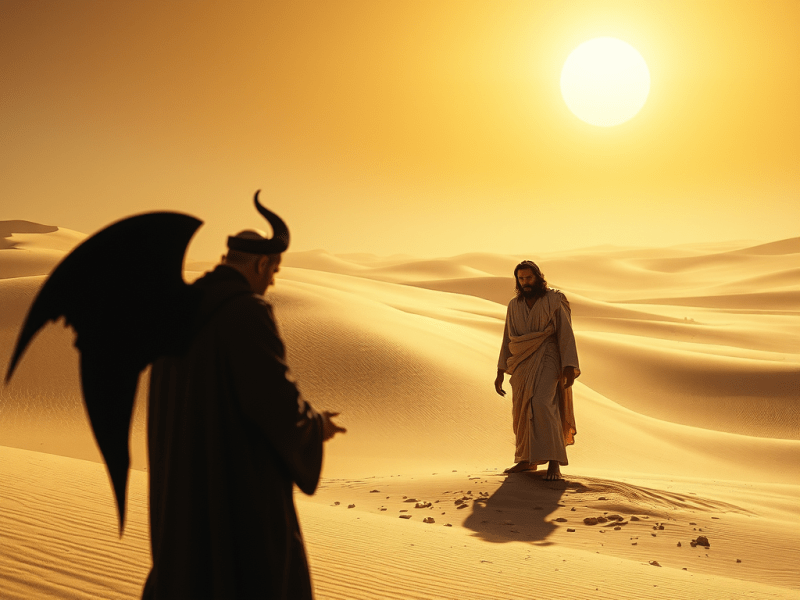
What’s behind this evil? Everyone in the Gospel speaks of the Devil, which is to say, some fallen, spiritual power that has come tragically to rule in individual hearts, institutions, and cultures. The Lord deals with sin and darkness in those domains, but appreciates them as manifestations of a more fundamental darkness: i.e., Satanic or demonic power, that he has come to battle.
And, where does Jesus do battle? On the Cross, where the struggle is finally and fully engaged. Nailed to the Cross is where Jesus did battle with all of those evils of dysfunction, but finally with the Prince of Darkness. Now, you see the apocalyptic converges in the great struggle and the battle is waged. Notice in telling the struggle of the Crucifixion, the Gospel writers use apocalyptic imagery: the earth shaking, the sun being dimmed, peoples in tumult.
People of God, the sin of the world came to crush the proper Ruler of the world. All the forces of evil and wickedness came to bear on the crucified Christ. This was the locus of the cosmic struggle and battle. And, how does Jesus do battle: fighting evil with evil, combating violence with more violence? NO! Jesus will demonstrate that by sacrificing himself for the love of human beings, that is the victorious power that can overcome evil. There is no other way: only sacrificial love exemplified by Jesus on the Cross can overcome.
The cosmic battle is waged on the Cross. But in the Resurrection, the King won his victory and then commenced to call his holy remnant from the four corners of the world. The Church—the one, holy, catholic, and apostolic—is that great community in the wake of the cosmic battle won by Jesus. Evangelization is all about Christ, summoning people from the four corners of the world to join this holy remnant that exists in the wake of this great cosmic struggle. The Lord Jesus is not only our destination—He is the Omega Point. But, he is also a constant presence in our lives; he is always beside us, he always accompanies us, empowering us to live the Good News in our time and place.
So, do you see why these strange stories from Daniel to the New Testament, these apocalyptic accounts have everything to do with us? Amen.


 WWW.DEACONJIM.BLOG
Leave a comment