1st Week of Lent (C); March 10, 2019
Deut 26:4-10 Ps 91 Rom 10:8-13 Lk 4:1-13
Deacon Jim McFadden; (New) Folsom Prison
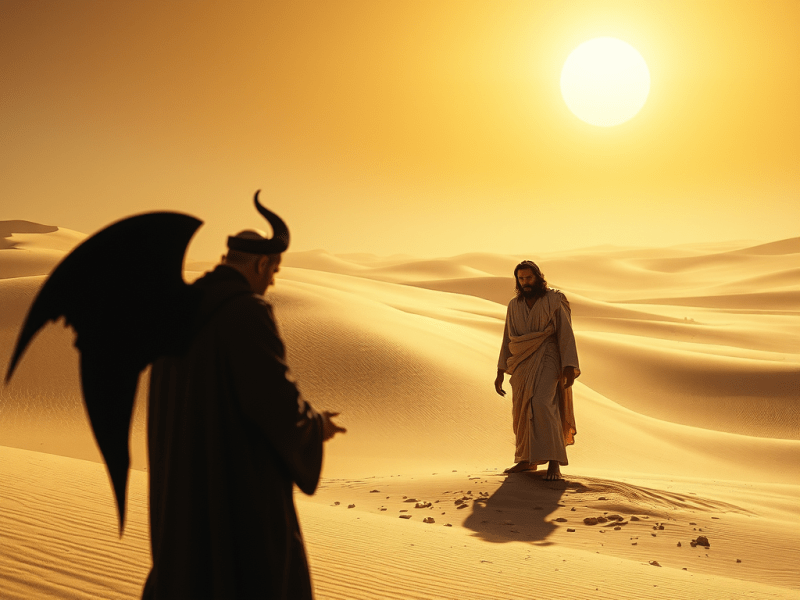
Brothers, we come, once again, to that great season of lent, which by its nature is a desert time, which is to say, a time of simplicity, purification, and asceticism. We notice in Luke’s account of the Temptation that the Spirit himself lead Jesus into the desert, not some wicked power, but the Holy Spirit of God that leads him there. As we begin our Lent, think of the Spirit that’s leading you into this holy place.
Notice that the great figures of salvation history—Abraham, Jacob, Joseph, Moses, David, Isaiah, Jeremiah, etc.—underwent a period of testing or trial, which is required before they can commence their work. Watch that pattern throughout the Bible. You see the same thing in the initiation rituals of primal people: before a young man can begin to undertake his life’s work, he has to go through a period of testing and trial. We see the same thing cinematically portrayed in Star Wars, e.g., where Luke Skywalker has to go through is own initiation.
The desert represents a stripping away so that the fundamental things might appear. In the desert there are no distractions, no secondary matters, no diversions. Blaise Pascal, the great mathematician and Catholic apologist, said that we spend most of our lives with diversions—things that distract us from essential matters. The desert is where you strip away diversions—everything is basic, necessary, simple. Just think if you were stranded in a desert: you’re not thinking about secondary or tertiary concerns, but your thinking about life and death. The desert concentrates the mind and heart. So, one discovers strengths and weaknesses that one didn’t know that he had; it’s like purifying a metal in fire.
Now, Jesus did not have to deal with sin like the rest of us do. But, in his humanity he certainly knew of temptation. Therefore, he had to confront the temptation towards certain negative things before he was able to undertake his work. In that way, we can all identify with his time in the desert. We can learn from his wrestling with the three basic temptations that we human being face: then we’re ready to resume our work.
So, we hear that he fasted for 40 days and when they were over, he was hungry, which seems like a vintage understatement! Satan temps him to turn the stones into bread. Now, there’s nothing wrong with bread or food and drink in general. We don’t adapt a Puritanical attitude towards these things. But, as every spiritual master has recognized, there is a problem with making sensual pleasure the most basic good of your life. And don’t think this is an off-the-board abstraction, but this is something that a lot of people do. It’s a hedonistic, sensualist, materialist attitude towards life: eat, drink, and be merry—food, drink, and sex become the dominant concerns of your life. If you doubt me, talk to anyone who’s become addicted to these things—a lot of people are addicted to food, alcohol and drugs, se and pornography. See this is what we get when extrapolate the temptation of turning stones into bread: it means turning sensual pleasure into the dominant force of your life.
Now, what do we learn from this encounter between Jesus and the Tempter? We learn that which is not most basic is the will and purposes of God. While there’s nothing wrong with the enjoyment of food, drink, sex ad other sensual pleasure, but what is most basic is doing the will of God. This is why the Lord counters with the admonition that “One does not life by bread alone” (Lk 2:4)—one of the more famous one-liners in the New Testament and is certainly worth reflecting upon. Life is not just about sensual pleasure. And, more to it, once we know what is basic, then we will know how to handle food, drink, and sex. Because if we don’t get the fundamental thing right, then those three good things will turn on us because we won’t know how to handle them properly. We don’t live by bread alone. Then what do we live by?—“By every word that comes from the mouth of God”—that’s the organizing principle of your life.
And, so people of God, Lent commences, as we enter into the desert, we can confront our temptations, our diversions. A good question to as, “Have I made sensual pleasure too central my life?” Can I hear echoing in my own heart these words that “one does not live by bread alone.”
The second temptation has to do with the lure of power, showing Jesus all the kingdoms of the world in a single instance (v. 5). The Devil said to him, “I shall give to you all this power and their glory…if you worship me” (vs. 6-7). Notice what a critique of world power this is. Indeed, I don’t know anywhere else in world literature where worldly power is so thoroughly criticized than right here. Why? All the kingdoms of the world are portrayed as belonging to Satan. Not some of them, not most of them: ALL OF THEM! Where does worldly power come from? It’s very clear from this passage that it comes from the Devil.
Now, we have to be careful because power in itself is not evil because God, after all, is described as being all-powerful. And, we hear over and over again that God is resplendent in glory. See, here’ the trick: when power and glory are worshiped, when they become central to our life, then we have a problem. God may invite some people to wield power and, indeed, to experience glory as part of his design. Think of some popes who have used power and glory prudently. Think of some political leaders—Lincoln, Churchill, FDR—who exercised power well, even we might say they were allotted power so that the could do some very good things and they covered themselves with glory.
But, God’s plan of you is not to amass power and glory and it might involve for you an absence of power and glory. In fact, God’s plan for you is that you become forgotten, even dishonored. Think of St. Therese of Lisieux, who lived in an obscure convent northwest of Paris, known to only her family and her fellow sisters in the convent. She had minimal power as she went about here simply daily tasks under the burden of tuberculosis. She was a nobody and died ignominiously at the young age of 24. Power and glory, she had none. But, she so thoroughly followed God’s will for her that she bas become the source of enormous influence.
Therese thoroughly embraced Jesus’ rejoinder to Satan: “You shall worship the Lord, your God, and him alone shall you serve” (v. 8). That’s the second question: what’s fundamental in your life? Power and honor or doing the will of God?
Finally, the Devil led Jesus to the parapet of the Temple and invited him to throw himself down confident that the angels would support him (v. 9). What’s at stake here is the aggrandizement of the ego. What was the Temple, but the epicenter of Jewish worship? It was the summit, the high point of Jewish life. Where does Satan place Jesus–the parapet of the Temple, which means the height of Israelite life. Brothers and sisters, this may be the very essence of sin; it’s what all us sinners do: we make ourselves into God because we imagine that we are the center of the universe, that life is about us, and that we are in control. Even the angels, even God himself will prevent me from being hurt.
As noted earlier, the purpose of the initiation rites was to inculcate the individual into this simple truth: your life is not about you! See, it’s about God and his purposes for you. So, we hear in the Lucan account, “You shall not put the Lord, your God, to the test” (v. 12). When you’re testing God, you’re putting yourself into a superior position with God. God tests people all the time in the Bible; that’s fine because that’s his business. But, when you test God, you’re putting yourself at the parapet of the Temple because you think the world revolves around you.
And, so, the final good Lenten question to ask: are you the center of attention? Are you on the parapet of the Temple? Are you willing to do the will of God? Brothers and sisters, go into the desert this Lent and ask yourself these fundamental questions and come to this simple and powerful self-knowledge.


 WWW.DEACONJIM.BLOG
Leave a comment