1st Sunday of Lent (B); February 18, 2024
Gn 9:8-15. Ps 25. 1 Pet 3:18-22. Mk 1:12-15
Deacon Jim McFadden
Each year the Church admonishes us to turn our faces once again to the mystery and heart of our faith: The Paschal Mystery of the living, dying, and rising of Jesus and our own living, dying, and rising with Jesus. The cycle of readings (B), taken primarily from the Gospel of Mark, insists that we alter our lives as individuals so that we can take our true place before God. To do that, we need to remember who we are—to live out of our truest Self.
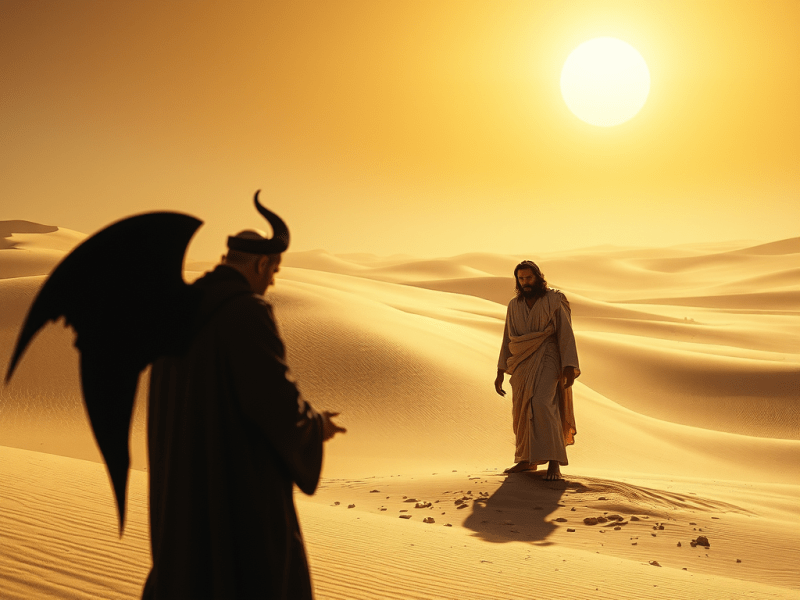
At his baptism by John the Baptist, Jesus in his humanity came to the full realization of who he is: the only begotten beloved Son of God. Once Jesus has that full awareness, “The Spirit immediately drove Jesus out into the wilderness” (Mk 1:12)– that place of recognition, a place where he faces his True Self and the false interpretations of what it means to be the Son of God. In the desert Jesus is among wild beasts, and the angels ministered to him. What happens to Jesus must happen to us. These three verses in Mark’s Gospel are the spiritual journey in a nutshell: coming to know oneself, facing the wild beasts and being ministered by angels.
The starting point of the spiritual journey is to recognize our True Self and to begin the process of living out of that reality. At Baptism we are initiated into
the Mystical Body of Christ, the Church, and thereby into Trinitarian Love. As we grow in faith, we come to recognize that we are the beloved children of God, which means we have nothing to prove, nothing to protect. Our self-worth is not earned but is given to us by a gracious God, Who is Love. So, we are who we are in relationship to God. As the prophet Zephaniah reminds us, God loves and delights in us (cf. Zep 3:17).
On the other hand, if we succumb to the seductions of our meritorious culture where we feel that we have to prove ourselves to others, that we have to protect our turf and privilege, that we give our allegiance to our tribal loyalties that are in opposition our Catholic fellowship and solidarity, then we will be living out of our False Self—we will be enslaved by our “wild beasts”.
But, once we know who we truly are, then we’re ready to deal with our Darkness, to wrestle with our “wild beasts”. Their voices will assault us, accuse us.
They will tell us what we’re not. If we listen to them, they will wreak havoc—they will divide us, pitting us one against the other.
The ancient Desert tradition identified these “wild beasts” as
• food (comfort, security)
• sex (hedonistic pleasure)
• possessions (wealth, consumerism)
• sadness (sense of loss, things are going my way)
• apathy (“to hell with it”; why bother?)
• vainglory (pride, being full of oneself; narcissism)
• pride (exceptionalism: my group is better than you.
People of God, we need to contend with the noise generated by the “wild beasts”. But, understandably, we’ll feel lonely as we deal with their seductive voices and lies. Our first response may be to take flight, to return to the world of distraction and busyness; to get lost in the internet as we form virtual worlds; to re-absorb ourselves in the drama of our individualistic, self-absorbed, acquisitive culture. Let’s resist that temptation and trust that the ancient Desert tradition was on to something; indeed, they were being psychologically and spiritually astute because we have to go into that place where we confront that negative stuff we need to come to terms with before we find God.
If we hang in there, if we contend with the wild beasts, we will then be able to collapse into that place where we will hear the voice of God. We’ll hear voices
that go beyond the False Kingdom. I promise you that if we wait long enough, we will eventually hear the voices of angels. If we listen close enough, if we face our loneliness, we will experience a breakthrough. If we face ourselves for who we are before God, we’ll experience this radical aloneness–that we are radically dependent upon God for life. We will realize that our life is no longer about me, but my life is about God.
At this point of surrender, we’ll meet the ministry of angels. We will experience consolations, voices that the post-modern secular culture cannot name because it is about having, acquiring, dominating, and controlling. The voices that we will hear will call us “beloved, good, a daughter or son of God.” They will be voices that are sweet, that console. These voices will not take away the “wild beasts,” but they do speak deeper and more strongly than the “wild beasts” ever can.
Brothers and sisters, we need to come into this kind of desert, where we can hear such voices —the ministry of angels. Let us pray to Mary Most Holy, that she may help us to welcome angels into our life, that we may be protected. Amen.


 WWW.DEACONJIM.BLOG
Leave a comment