24th Sunday in O.T. (B); September 15, 2024
Is 50:5-9a. Ps 116. Jas 2:14-18. Mk 8:27-35
Deacon Jim McFadden
We know this scene well: Jesus is the area of Caesarea Philippi and asks his disciples, “Who do people say that I am?” (Mk 8:27). After the report of the common consensus, he probes further by asking them, “But who do you say that I am?” Peter pipes up and said, “You are the Messiah” (v. 29).
Peter got the answer right, but as the story unfolds his understanding on what ‘Messiah’ meant was a lot different than Jesus’. For centuries Jews had been waiting for a deliverer from the line of David, who would liberate Israel from its enemies, who would gather the tribes into one great nation again, and who would make Israel a light to the world—all of that was the Messiah’s job description. Now, while all of that is true, Peter meant it in a political and militaristic sense, which explains what happens next.
Following Peter’s proclamation that Jesus is the Messiah, he then begins to teach his disciples just what that entails, which contains the first prediction of his Passion. He begins by saying that “…the Son of Man must suffer greatly, and be rejected by the elders….and be killed” (v. 31). Jesus is drawing from an obscure, minority opinion of the Messiah prophesies by Isaiah, contained in our first reading in which the anointed one “…gave my back to those who beat me, my cheeks to those who plucked my beard; my face I did not spare from buffets and spitting” (Is 50:6). Hmm, this doesn’t seem like a standard expectation of the Messiah.
Coming from this conventional view, Peter, who had just professed faith in Jesus as the Messiah, rebukes him for saying what he did. Yes, you are the Messiah, which means that you should be powerful, victorious; you should be a military hero like David and Solomon. You can’t do that if you are rejected, that you suffer, and that you are killed. All of that would be a sign you are not the Israelite Messiah.
But Jesus comes right back at Peter, which may be the most startling and disturbing words in the entire New Testament. Speaking to Peter, who would become the first pope of the Catholic Church, he says, “Get behind me Satan. You are thinking not as God does, but as human beings do” (v. 33b).
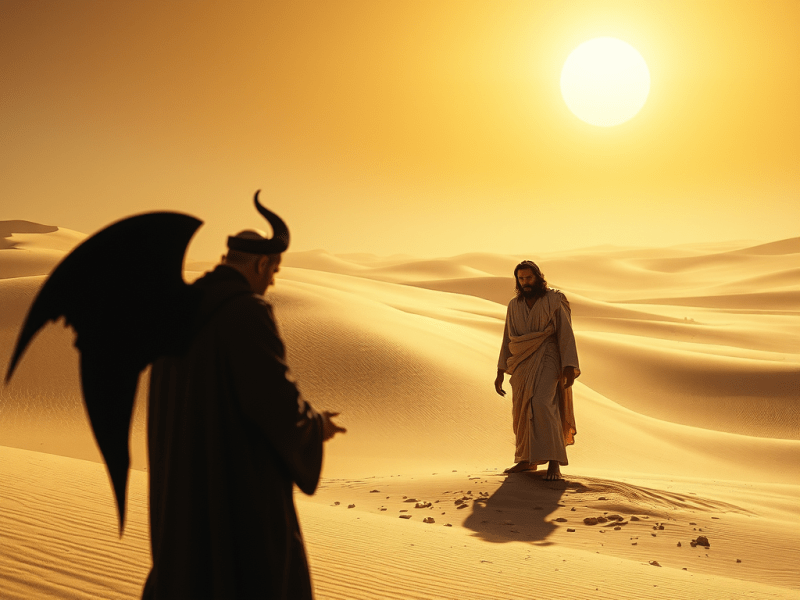
How do human beings think? What are the things that Peter chooses, the “human things”? Since Jesus raises the specter of Satan, it behooves us to circle back to the concrete temptations Satan offered Jesus in the desert. It doesn’t seem that Jesus is identifying Peter with Satan, but the former is thinking like Satan. How so? In the guise of helping Jesus, Peter is leaning into the basic temptations that underlie what “human beings do.”
In the temptation accounts, Satan misinterprets what it means to be the Messiah, by offering Jesus power to satisfy his earthly hungers, the power to use God’s power to save him from harm, and power to acquire the kingdoms of the world. Wealth, fame, power—what more could a person want? With this kind of thinking, Peter did not want Jesus to die at the hands of the Romans, but to institute God’s kingdom by conquering them militarily and installing himself as king. The “human things” of Peter involved shows of force, might, and revenge. That’s the way the Messiah was imagined according to Peter.
Jesus, on the other hand, will reveal through his teaching and his Passion, how the true Davidic Messiah responds to Israel’s enemies. Here’s the irony: does Jesus fight Israel’s enemies? Yes, he does! But, how does he do that? He does so by absorbing the world’s hatred, dysfunction, hypocrisy, revenge, and violence by love, forgiveness, and mercy—thereby transforming it. Nailed to the cross, he can say, “Father, forgive them for they know not what they do” (LK 23:34). Jesus absorbs the violence of the enemies of Israel, which means the violence of sin, of the way of the world. Jesus doesn’t perpetuate the cycle of violence and sin, but brings it to an end.
Whatever kingdom that Peter had in mind that he wanted the Messiah to usher, it probably did not involve denying oneself, taking up one’s cross, following Jesus, and losing one’s life for the Gospel. What kind of kingdom is that? Who wants a Messiah like that? What kind of ridiculous kingdom is built upon the broken body of a defeated Messiah that Isaiah described?
Jesus is inviting us into the Kingdom of God which is about “divine things,” which only comes about through repentance or conversion: namely, to change our old way of thinking and to embrace a new way, that of Christ-consciousness. Tomas Halik, a Czech priest and theologian put it this way,
“If we have never had the feeling that what Jesus wants of us is absurd,
crazy, impossible, then we’ve probably either been too hasty in taming
or diluting the radical nature of his teaching by soothing intellectualizing
interpretations, or …we have too easily forgotten just to what extent—
in our thinking, customs, and actions—we are rooted ‘in this world’ where
totally different rules apply” (Night of the Confessor, p. 27).
Jesus offers us “the things of God,” the things in which we save our lives by losing them and build a kingdom whose divine power is seen as human weakness. There is power in this Gospel text: it shows us what it means to follow Jesus, the Messiah, the Christ.
Let us ask our Blessed Mother to help us encounter her Son, Jesus, and to be transformed by Him. Amen.
Reflection Questions:
- Who did you say Jesus was when you were younger? What do you say today?
- Why did Jesus refer to Peter as “Satan.” Does that exchange bother you?
- In terms of behavior, is your life about “divine things.” How so?


 WWW.DEACONJIM.BLOG
Leave a comment