CHRIST THE KING
34th Sunday in Ordinary Time; November 22. 2026
Ez 34:11-17; Ps 23:1-6; 1 Cor 15:20-28; Mt 25:31-46
Deacon Jim McFadden
Sometimes, I wonder why the Church still celebrates this feast day. Today kings or queens do not have many powers. Their countries are usually run by elected governments. The Church cannot be saying that Jesus is old-fashioned and powerless. What does it mean that Jesus Christ is our king?
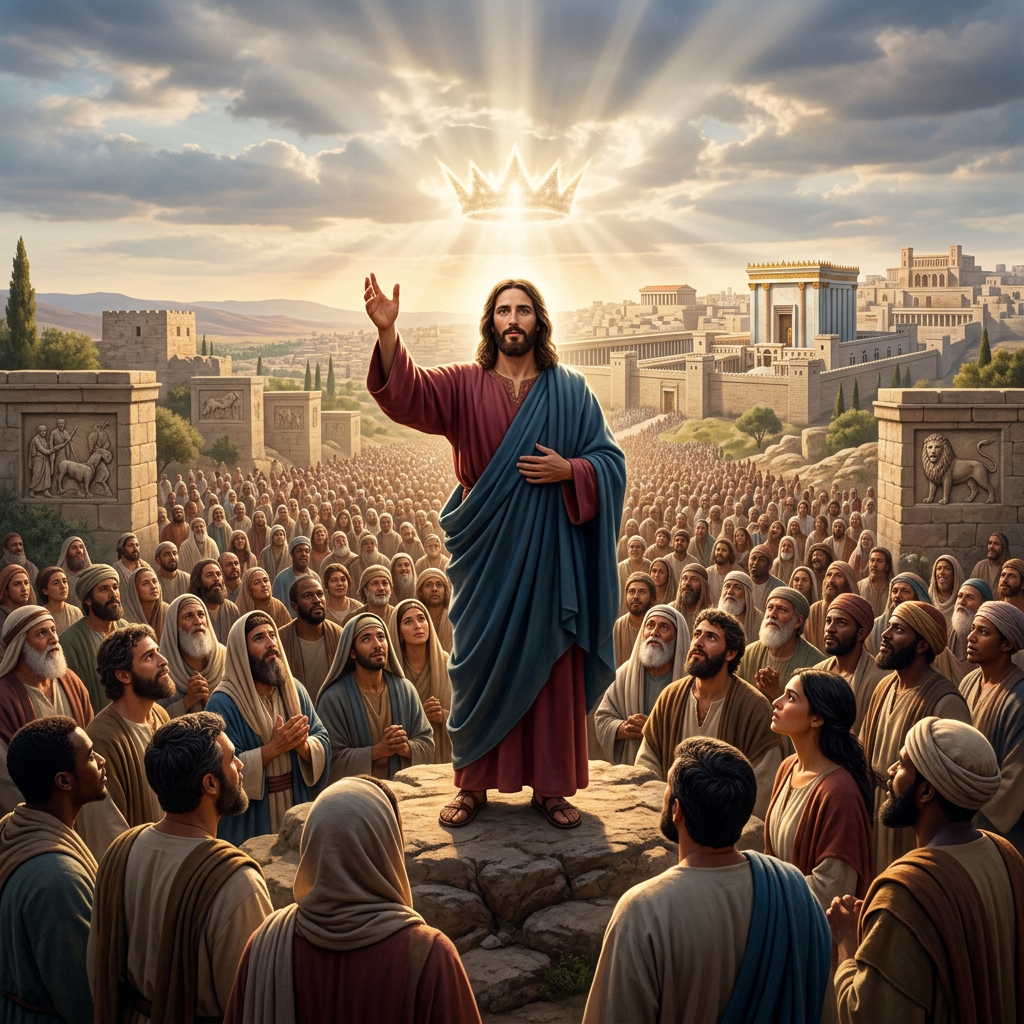
The very first public words out of Jesus’ mouth proclaimed the gospel of the kingdom. These words appealed to the Jews listening to his preaching, because they remembered King David, who had gathered the twelve tribes of Israel into one kingdom, had established Jerusalem as Israel’s capitol, defeated Israel’s enemies, ushered in a period of unparalleled glory and prosperity, and resolved to build the temple as a place of right praise. He had been their head, their leader. They dreamed of a new David: a new king who would do everything that David had done, but on a grander scale. They hoped that this king, the Messiah, would unite the nation definitively, cleanse the temple from its corruption, defeat Israel’s enemies completely, then reign over the whole world, not just Israel, so that all nations would be brought into worship of the one true God.
But Jesus was not proclaiming a worldly kingdom, a kingdom that would dominate others. His kingdom would include the poor, the marginalized, and sinners. This became very clear when Jesus stands before Pontius Pilate, the Roman governor who is the representative of Caesar Augustus. Pilate, undoubtedly sure of his power and authority, sizes up this criminal in front of him, probably with a smile on his lips; perhaps even a sneer. He says, so “Are you the King of the Jews?” (John 18:33b). Now, Pilate meant this in a purely political way: he was wary of anyone trying to seize political control of this part of the Roman Empire. Mind you, Pilate knew of such pretenders to power; there were all kinds of revolutionaries, of wannabe kings proposing themselves as an alternative to Caesar. Jesus wasn’t the first one to make such a claim.
Listen very carefully to how Jesus answers him. He tells him straightforwardly that “My kingdom does not belong to this world” (v. 36a). This is important because the Kingdom he has been announcing from the beginning of his public ministry is not part of the political order which maintains its authority through threats and violence. This is why he clarifies that his attendants would not “…be fighting to keep me from being handed over” (v. 36b). No, the kingdom of God he is proclaiming is one of non-violence, a compassionate ordering of things, and an outreaching to the poor and marginalized. He overcomes order which maintains its authority through threats and violence. This is why he clarifies that his attendants would not “…be fighting to keep me from being handed over” (v. 36b). No, the kingdom of God he is proclaiming is one of non-violence, a compassionate ordering of things, and an outreaching to the poor and marginalized. He overcomes violence by absorbing it in Divine Love and asks His Father to forgive the perpetrators of violence for they know not what they do.
During the Eucharist Jesus gathers us all around the altar. A worldly kingdom would be concerned about who’s in and who’s out. But, as we gather at Mass, we become the realization of the great vision proclaimed by St. Paul when he said, “there is neither Jew nor Greek, there is neither slave nor free person, there is not male and female” (Gal 3:28). When Dorothy Day, the co-founder of the Catholic Worker movement which serves the poor, was considering her conversion to Catholicism, she attended Sunday Mass at St. Patrick’s Cathedral. Though the Liturgy was in Latin, a language she didn’t understand, and the ritual was surrounded by elaborate and grand actions, she was deeply impressed by the fact that both the rich and the poor, both the educated and uneducated, both the housekeeper and the 5th Avenue socialite were kneeling side by side. That’s how Jesus gathers the tribes. Though the Liturgy was in Latin, a language she didn’t understand, and the ritual was surrounded by elaborate and grand actions, she was deeply impressed by the fact that both the rich and the poor, both the educated and uneducated, both the housekeeper and the 5th Avenue socialite were kneeling side by side. That’s how Jesus gathers the tribes.
John says, “When the Son of Man is raised up, he will draw all people to himself” (12:32) because he is the new King. He is the one to whom final and absolute allegiance is due. He is our King. Now the question becomes whom do you say He is? Does he live in your heart and rule your life with His Love?
Brothers and sisters, the Kingdom of God begins right here and now. Let us ask the Blessed Virgin Mary to teach us to reign by serving. Our Blessed Lady entered the Kingdom of Heaven by becoming the Queen of Heaven, through the door of humble and generous service. Let us do the same. Amen.


Leave a Reply