27th Sunday of Ordinary Time (A); October 4, 2026
Is 5:1-7. Ps 80. Phil 4:6-9. Mt 21:33-43
Deacon Jim McFadden
The parable about the mismanagement of the vineyard tells us a
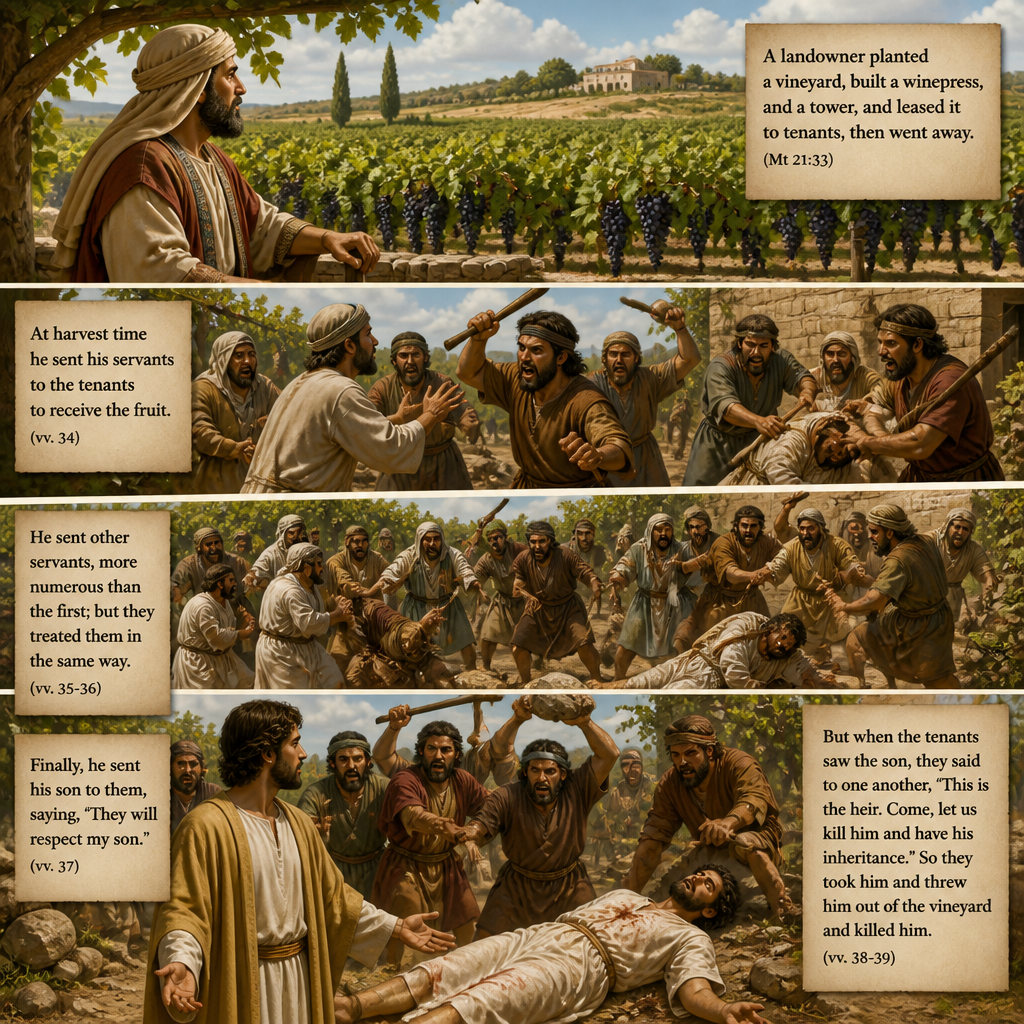
lot about the Kingdom of God, the choices we make, and the God who is always faithful in his forgiveness and mercy. As a visual aid to our reflection, I encourage you to check out James B. Janknegt’s The Wicked Tenants, as a meditative icon as we unpack the spiritual meaning of this parable.
This allegorical story describes to us a landowner who, after having taking great care of his vineyard (cf. Mt 21:33), had to depart and leave it in the hands of farmers. Then, at harvest time, he sends some servants to collect the fruit, but the tenants welcome the servants with a beating, and some even kill them. The household owner sends other servants, more numerous, but they receive the same treatment (cf. vv. 34-36). The peak is reached when the landowner decides to send his son: the vine growers have no respect for him; on the contrary, they think that by eliminating him they can take over the vineyard, and so they kill him too (cf. vv. 37-39).
The image of the vineyard is clear: it represents the people the Lord has chosen and formed with such care; the servants sent by the landowner are the prophets, while the son represents Jesus. And just as the prophets were rejected, so too Christ was rejected and killed.
As we stand before this parable, let us not think that it only applies to those who rejected Jesus 2,000+ years ago. It applies to all times, including our own. There are two dynamics at work here. To begin with, the parable shows the intentionality of the landowner: namely, he really cares for those whom he has leased the land and wants them to have access to the fruits of their labor. In short, the landowner, who stands for God the Father, has done everything he can for our well being. In the first reading from Isaiah, the owner plaintively asks, “What more was there to do for my vineyard that I have not done it” (Isaiah 5:4).
Given all of this, how do the tenants, how do we respond? Put simply, they want it all, they want the vineyard, but without God! They assume a grasping, possessive attitude. Put simply, they want to take possession of the vineyard, which is a metaphor for all things. In their greed, they do not want to give anything to the owner. They’re basically saying that the fruits of their labor belong to them alone. They don’t have to be accountable to anyone.
The Wicked Servants are living a lie. They should be grateful for what they have received and how they have been treated. Instead, their lack of gratitude leads to greed and a progressive sense of rebellion, which lead them to see life in a distorted way, to feel that the owner was in their debt rather than the other way around! That’s why they mistreat the servants, to the point of killing them. They want the vineyard for themselves but without God the owner. They are not happy with the status of tenants, who are radically dependent upon the owner for everything they are and have. That’s why they have to get rid of the Son, so they can have the inheritance. Eventually, they can be the owner, they can be God, which replays the story of The Fall in Genesis 3.
With this parable Jesus is teaching us what happens to people when they think that they are self-made, which leads to ingratitude. They forget the real foundation of life, in which good comes from the grace of God, which is a gratuitous gift. When one forgets this gratitude towards God, we navigate through life no longer with the joy of experiencing love and being saved, but rather with the illusion of needing neither love nor salvation. These people, symbolized by the Wicked Servants, stop letting themselves be loved and they become prisoners of their greed as they grasp for the goods of the world in order to be happy. This process is ugly and we see it played out in our society today which is marked by so much greed, corruption, hostility, resentment, and retribution.
Brothers and sisters, if we give into the culture of resentment, conspiracy theories, misunderstandings, and envy we can fall headlong into a spiral of violence within our borders and internationally. Put simply, ingratitude inevitably leads to violence—psychologically or physically—which drives away peace and makes us regard others as our enemy.
So, let us ask ourselves: am I aware that I have received the gifts of life and faith? Am I aware that I myself am a gift towards others. Do I believe that everything—EVERYTHING—comes from the grace of our Lord? Am I aware that without any merit on my part, that I am beneficiary of God’s love and that I have been saved gratuitously. And, above all, do I know how to say “thank you” to God and my brothers and sisters?
May Mary, whose soul magnifies the Lord, help us make gratitude the light that dawns daily in our hearts. Amen.


Leave a Reply