28th Sunday in Ordinary Time (A); October 11, 2026
Is 25:6-10a. Ps 23. Phil 4:12-20. Mt 22:1-14
Deacon Jim McFadden
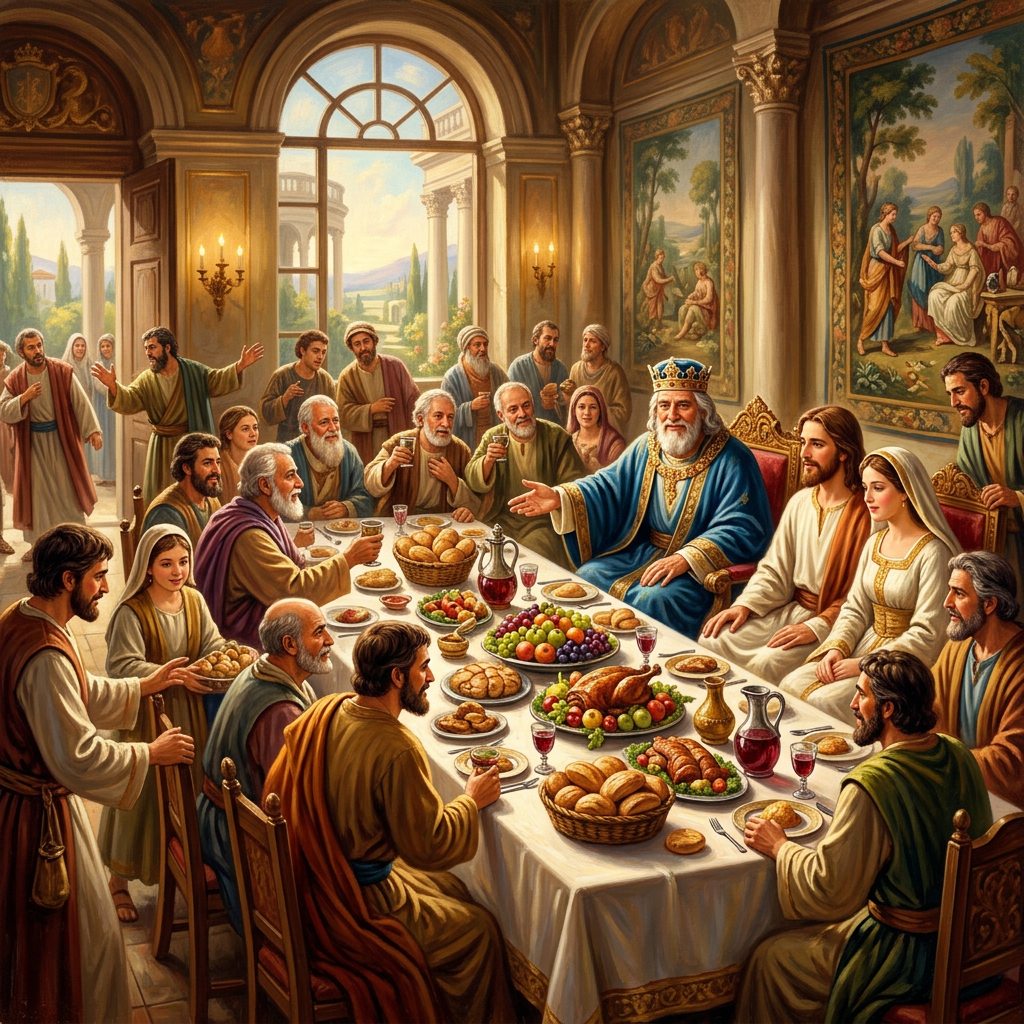
The parable we hear in today’s Gospel tells us a lot about the Kingdom of God, which is likened to a king who throws as wedding feast for his son. Notice that father (God the Father) is giving a banquet for his son (God the Son), whose bride is the Church. Jesus is the marriage of divinity and humanity—and his followers are invited to join the joy of this union.
The Father out of the goodness of his heart sends out the invitation but he does not compel anyone to accept which exposes him to rejection. Nonetheless he prepares a lavish banquet, freely offering the invited guests the opportunity to encounter his son and to enjoy a sumptuous feast. The joyful intimacy that is shared between the Father and the Son is now offered to us. Listen to Isaiah in our first reading who describes the details of this banquet: “On this mountain the Lord of hosts will provide for all peoples a feast of rich food and choice wines, juicy, rich and pure, choice wines” (Is 25:6). This is what God is preparing for us: a banquet, to be in communion with the Triune God and fellowship among ourselves. And, all of us, are therefore God’s invited guests. But a wedding banquet requires time and commitment on our part: do I say “yes” or “no” to God’s invitation. God invites, but he leaves us free to accept or not.
This parable reveals the type of relationship that God wants for us. He calls us to stay with him, to participate in the wedding feast, but leaves the possibility to accept or reject the invitation. God does not propose a relationship of subjection—of a superior to a subordinate—but rather one of fatherhood and sonship: of being son or daughter of God. Such a relationship cannot be imposed but is necessarily conditioned by our free consent. Just as God respected the Virgin Mary’s freedom at the Annunciation, he respectfully does the same with us. Why does God act this way towards us? St. Augustine nailed it when he used a beautiful expression in this regard: “He who created us without our help will not save us without our consent” (Sermon CLXIX, 13). Now, God being omnipotent does have the capacity to do so but because God is Love, he respects our freedom fully. God proposes: he does not impose. Never.
Getting back to the parable, what happens? The king is basically getting stood up! We hear, he “sent his servants to call those who were invited to the marriage feast; but they would not come” (Mt 22:3). This is the drama of the story: the invited guests said “no” to God. That is an awful, inappropriate use of one’s freedom, but the guests were not awful abject sinners. Instead, they were ordinary folks who were simply caught up in their own affairs—they had “better” things to do, such as tending to their fields and business. They were more interested in having something they thought was important—namely, the goods of the world—rather than risk something that the wedding demands. You see, brothers and sisters, this is how love grows cold: it doesn’t necessarily happen out of malice but out of a preference for what is our own: my security, my status, my pleasure, my control.
Undaunted, the king does not give up; he expands the invitation list, he continues to invite. He keeps sending out invites until he finds someone who will accept it. And who are they who say “yes” to his invitation? THE POOR, who underscore the 1st Beatitude, which reveals so much about Kingdom people. Those that accept the invitation are those who know they have little else, many come, until they fill the hall (cf. vs. 8-10).
Let us ask ourselves, then, how do I respond to God’s invitations? What space and time do I give him in my days? Does the quality of my life depend upon my affairs and what I deem to be important or does it depend upon my love for the Lord and my brothers and sisters, especially the poor, those most in need?
May Mary, who with her “yes” made room for God, help us not be deaf to his invitations. Amen.


Leave a Reply